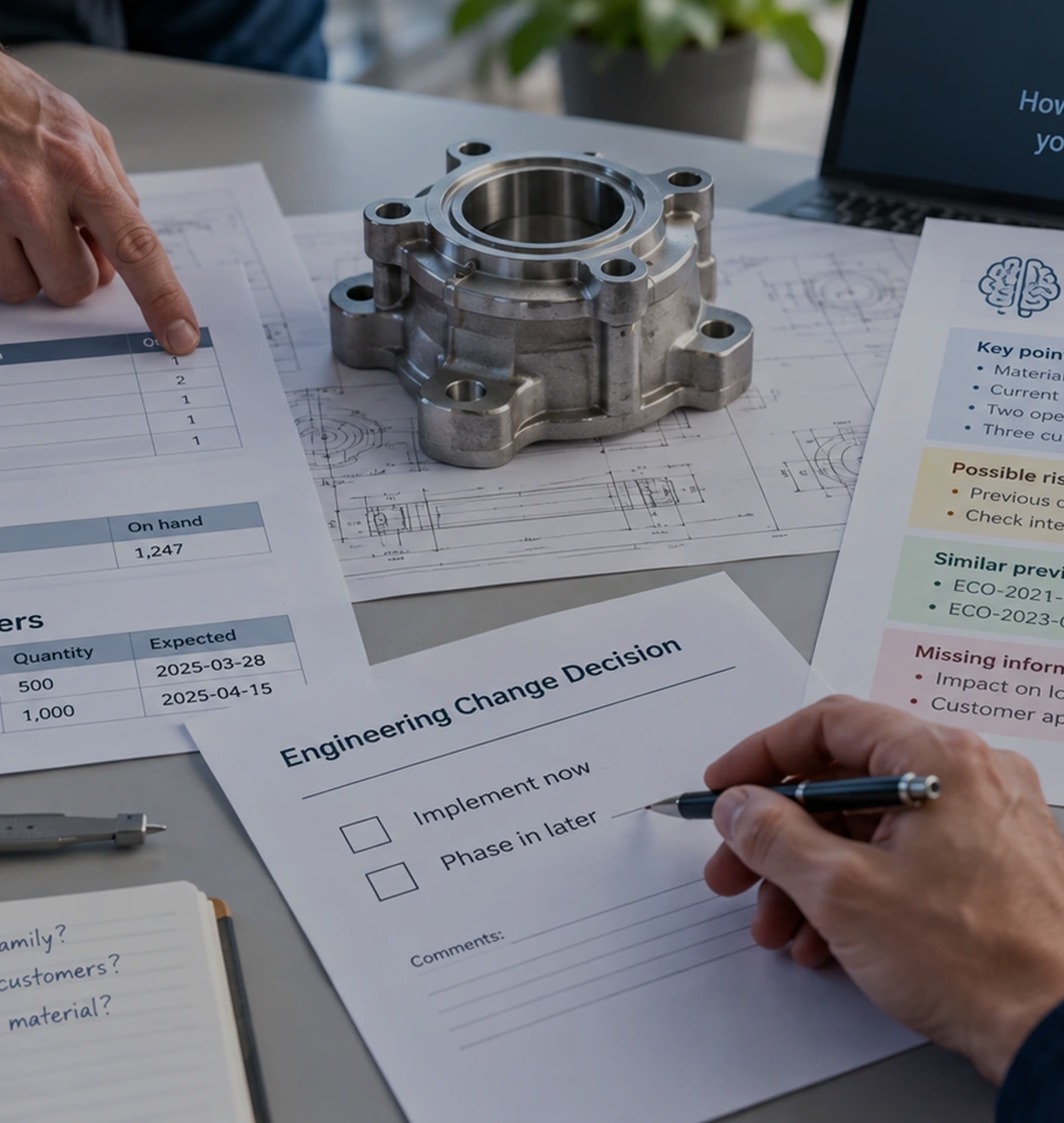
Turn engineering change into business performance.
Engineering Change Management is an enterprise-wide discipline. Changes may originate in engineering, production, service, quality or elsewhere — and their consequences can reach across products, processes, sites, suppliers, systems and customers.
Only when a change is fully implemented is its value realised.
A change may originate in Engineering, Production, Service or elsewhere — but its impact can extend across products, processes, systems, sites and operational data.
Managing the technical change is therefore only part of ECM. Effective Engineering Change Management coordinates the complete change across the affected functions, information and systems — from the initial need through release and full implementation.
No value is realised until the change is fully implemented.
Speed
Better priorities, planning and coordination reduce waiting time and shorten implementation.
Cost
Earlier visibility reduces rework, obsolete stock and avoidable implementation cost.
Quality
A structured process helps ensure the complete change is understood and consistently implemented.
Prioritisation
Use available resources on the right changes to optimise value, balancing speed and cost.
How BoostPLM can help
LEARN
ECM Masterclass
Build a shared understanding of effective ECM among managers and ECM Subject Matter Experts — including prioritisation, impact analysis, planning, governance and line of sight from Change Request to phase-in.
Understand your current ECM capability, identify the greatest opportunities for improvement and establish a practical direction for processes, organisation and systems.
Develop and implement ECM processes, governance, roles, responsibilities and supporting systems adapted to your organisation — from high-level design to practical implementation and adoption.
A practical introduction to ECM, why it matters, and how changes are coordinated across the enterprise from identification to release and implementation.
Choosing an Engineering Change Management solution goes beyond change approval. This checklist highlights 16 questions to evaluate support across people, systems, data, cost, planning and implementation.
ECM requires more than knowledge of a single process or system. We combine ECM expertise with a broad understanding of the organisation, product information and enterprise systems around it.
Proven ECM Expertise
Experience establishing and improving Engineering Change Management across complex organisations.
Enterprise-Wide Perspective
We consider the complete change across engineering, production, purchasing, quality, service and other affected functions.
Deep PLM and ERP Knowledge
Understanding of the systems, product information and operational data on which effective ECM depends.
Process and Systems Together
Processes and supporting systems are considered concurrently so that each enables the other.
Industrial Experience
Practical experience from engineering, manufacturing and product-driven organisations.
Technology Independent
Recommendations are based on the organisation’s needs rather than a particular software vendor.
We use cookies to personalize content, provide social media features, and analyze our traffic. We also share information about your use of our site with our analytics partners. You can change your preferences at any time. For more information, please see our Privacy Policy and Cookie Policy. Privacy PolicyCookie Policy