

A Quick Introduction to Enterprise Change Management
In recent years, a new perspective on ECM has emerged focusing on a broader and more holistic understanding of ECM. At BoostPLM, we are dedicated to this approach that is often embraced by the term Enterprise Change Management.
The shift from Engineering Change Management to Enterprise Change Management emphasizes the need to go beyond the engineering department when dealing with changes. We need to understand the full picture when we request, plan and execute changes.
Following this approach assumes some prerequisites. To achieve the “full picture”, organizations must be in control of relevant information and data, and furthermore, they must be able to accommodate collaboration between the various departments and stakeholders. It requires the ability to know the impact of a change across the entire value chain and to have an overview of how multiple changes interconnect and relate.
Engineering Change Management in D365FO
The module of Engineering Change Management in D365FO is designed to manage different kinds of changes; product versions, engineering approvals, BOM revisions.
The module is a strong tool for companies within the manufacturing domain to control their product structure, releases and revisions. It also provides workflows for handling Engineering Change Requests (ECRs) and Engineering Change Orders (ECOs) in a structured manner.
All this makes the tool highly useful for handling regulatory compliance and structured workflows for approval.
Although the ECM module in D365FO is well-functioning and a strong tool for its purpose, it however still falls short when it comes to an Enterprise Change Management approach to changes.
The module’s strong focus on operational data and product structures makes it a robust solution for the operation-focused part of changes. There is no reason to not reap the benefits of it’s well functioning opportunities to support handling of product data and revisions.
The Silo Problem
While being a strong tool, the limitation of the ECM module in D365 therefore lies in the aspects of your change process that reach outside of the product change itself. When both processes, data and resources involved in the change all fall within an operational context, you risk a siloed view and handling of changes.
The same silo effect is present in other systems with relevance for ECM like PLM or PDM systems. In these systems, we often have the same case of narrow focus on the change – and often in the engineering department.
If you wish to pursue a more holistic approach to ECM, this becomes a limitation and a risk of duplicate work, broken traceability, and manual coordination across departments and outside of the defined workflows. Furthermore, performing thorough impact analyses becomes a major, manual task when it is performed in siloes where information is gathered to create an overview for each single change.
In other words, when pursuing an Enterprise Change Management approach, you need to connect the otherwise siloed sources of information; both people and systems. A part of this is connecting your D365FO ECM to other relevant systems.
End-to-End Engineering Change Management Process Across your Business
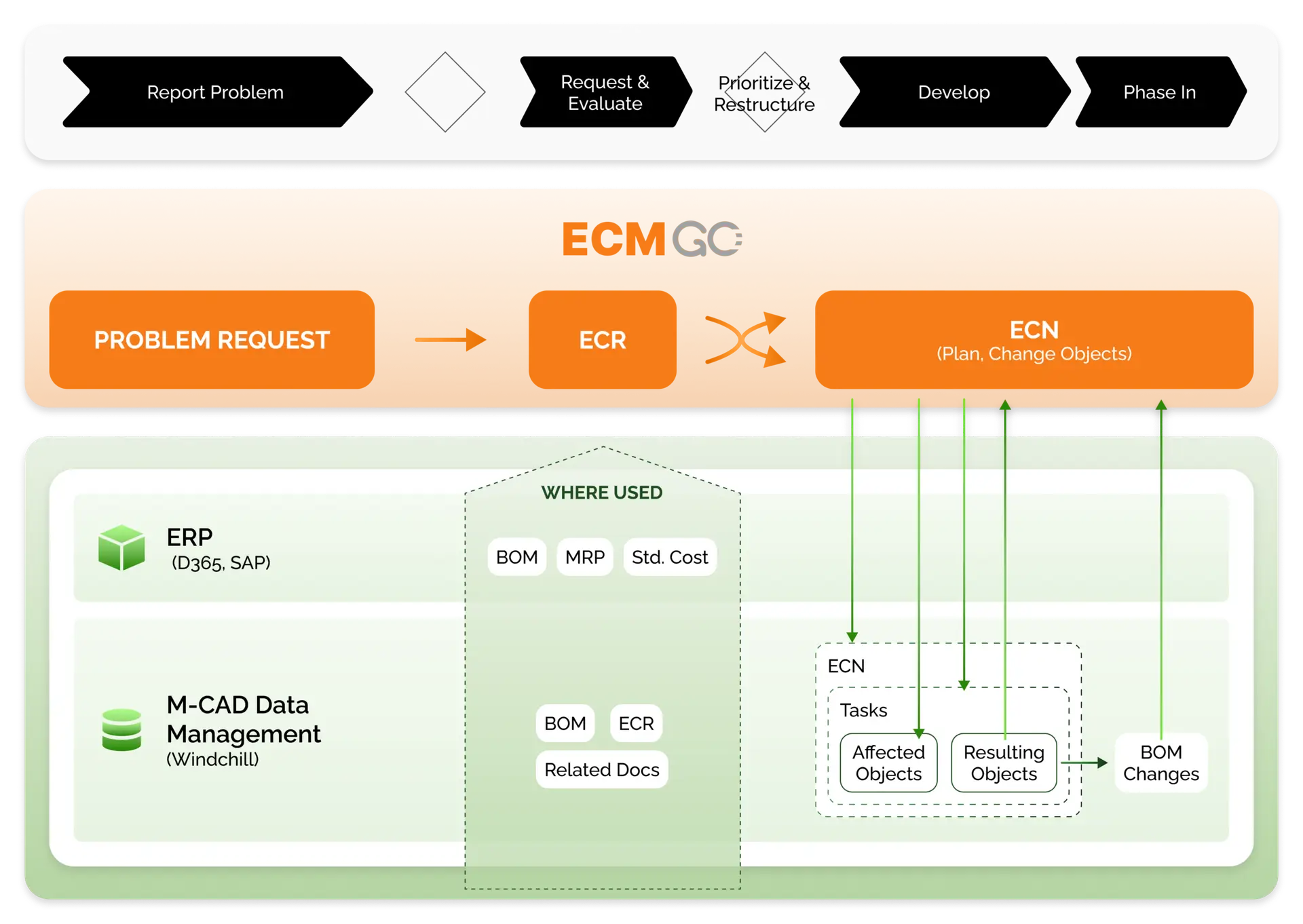
To embrace the full potential of D365FO’s ECM module, you need to make it a part of a bigger picture; an ECM end-to-end process that includes your entire business. This means that you can advantageously connect your D365FO to other systems and data sources by building an ECM-dedicated layer on top; a solution that connects with your existing solutions to create one, single system built for integration. One place to gather your entire ECM process when it comes to not only systems like PLM and ERP but also people, processes, departments and so on.
This will enable a holistic, data-driven change management system that spans across your business both when it comes to departments and systems. It allows for all stakeholders to collaborate on both the assessment and execution of a change, as well as it allows for visibility of the status and progress of changes.
At BoostPLM, we have solved this issue with a software solution that handles the integrations for you. It combines your PLM system with D365FO – and potentially other relevant enterprise systems – and supports you in handling your changes end-to-end while also letting you reap the benefits of the D365FO ECM module for the product focused part of your ECM process.
If you want to learn more about either Enterprise Change Management, ECM in D365FO or our own ECM-Go solution, do not hesitate to reach out.
We are always happy to join a non-binding conversation about ECM.
